Following a rigorous selection process, we are pleased to present the following five-minute EAGxVirtual 2020 lightning talks:
- Cecilia Tilli: Antimicrobial resistance: A cause that joins global health and development with longtermism and biosecurity?
- Noga Aharony: Aiming toward a biosecurity career from grad school
- Jennifer-Justine Kirsch: The next frontier: Lessons learned from an EA fish startup
- Sid Efromovich: Introducing Generation Pledge
- Michael Aird: Why we need a database of existential risk estimates
- Jessica McCurdy: The case for virtual cross-university fellowships
- Roy Head: Development Media International and COVID-19
- Juan Bartolomé García Martínez: Microbial protein as food for the apocalypse
- Jack Lewars: Open a 'One for the World' chapter and change the world
- Frankie Andersen-Wood: I'm not qualified to give this talk
- James Fodor: Pitfalls of Bayesian reasoning
- Chloe Dempsey: Cultivated meat: Does the Chinese consumer have an appetite?
We've lightly edited the talks for clarity. You can also watch them on YouTube and discuss them on the EA Forum.
Moderator: Hi, everyone. Welcome to EAGxVirtual 2020 lightning talks. We're about to watch 12 videos submitted by attendees just like you, on topics ranging from biosecurity, to cultivated meat, to donation pledges, to imposter syndrome. Some of our speakers represent EA organizations. Others are individuals presenting their own thoughts and experiences, or research that they've done in their spare time.
Their work demonstrates the depth, scope, thoughtfulness, and commitment to action that the EA community brings to the challenge of doing good better. We're proud to share these talks with you today.
Cecilia Tilli: Antimicrobial resistance: A cause that joins global health and development with longtermism and biosecurity?
Hi. My name is Cecilia Tilli, and I am the Secretary General of the
Foundation to Prevent Antibiotic Resistance. I will speak briefly about antimicrobial resistance and how this could be a cause that joins global health and development with longtermism and biosecurity.
First, some quick background information on antibiotic resistance: This is what happens when we use antibiotics against bacterial infections, and the bacteria evolves so that the treatment becomes ineffective. This is estimated today to cause about 700,000 deaths annually, and it's expected to cause about 10 million deaths annually by 2050.
Let’s take a look at the drivers of antibiotic resistance. The problem is that some infections in humans are resistant to antibiotics. Perhaps the most well-known driver of this is the antibiotic treatment of viral infections. This is considered a misuse of antibiotics because antibiotics do not work against viruses. So you get all of the side effects, but none of the benefits of the treatment. Also, it drives antibiotic resistance. This happens because prescribers are not following guidelines. It can also happen for many other reasons — for example, because of a lack of diagnostics, because antibiotics are sold without prescriptions or at patients’ [request], or because of other drivers linked to poverty.
A different driver is therapeutic, justified antibiotic treatment. Correct treatment also drives resistance, [mainly due to] both the lack of alternatives and the amount of infections. The drivers for infections, in turn, include factors such as urbanization, travel, hand hygiene, and weak immune systems. They also include factors such as suboptimal policies and research allocation and a lack of health education —which again, can be linked to poverty.
Then there is a group of drivers related to the agricultural use of antibiotics, and another related to transmitting resistance infections in healthcare.
If we map all of the drivers, it looks like this:
This is obviously a very complex image. If we want to prevent antibiotic resistance in an effective way, we need to analyze the situation and [strategically target the most influential] drivers.
In the past 10 or 20 years, interest in, and awareness of, antibiotic resistance have grown, and many more resources are now allocated to it. But my impression is that quite a lot of these resources are still not allocated in the best way. For example, resources are spent on information campaigns that lack a solid evidence base. Also, a lot of interventions are done without properly measuring the effects and following up, so that we know if [potential solutions are useful and worth expanding] to other places.
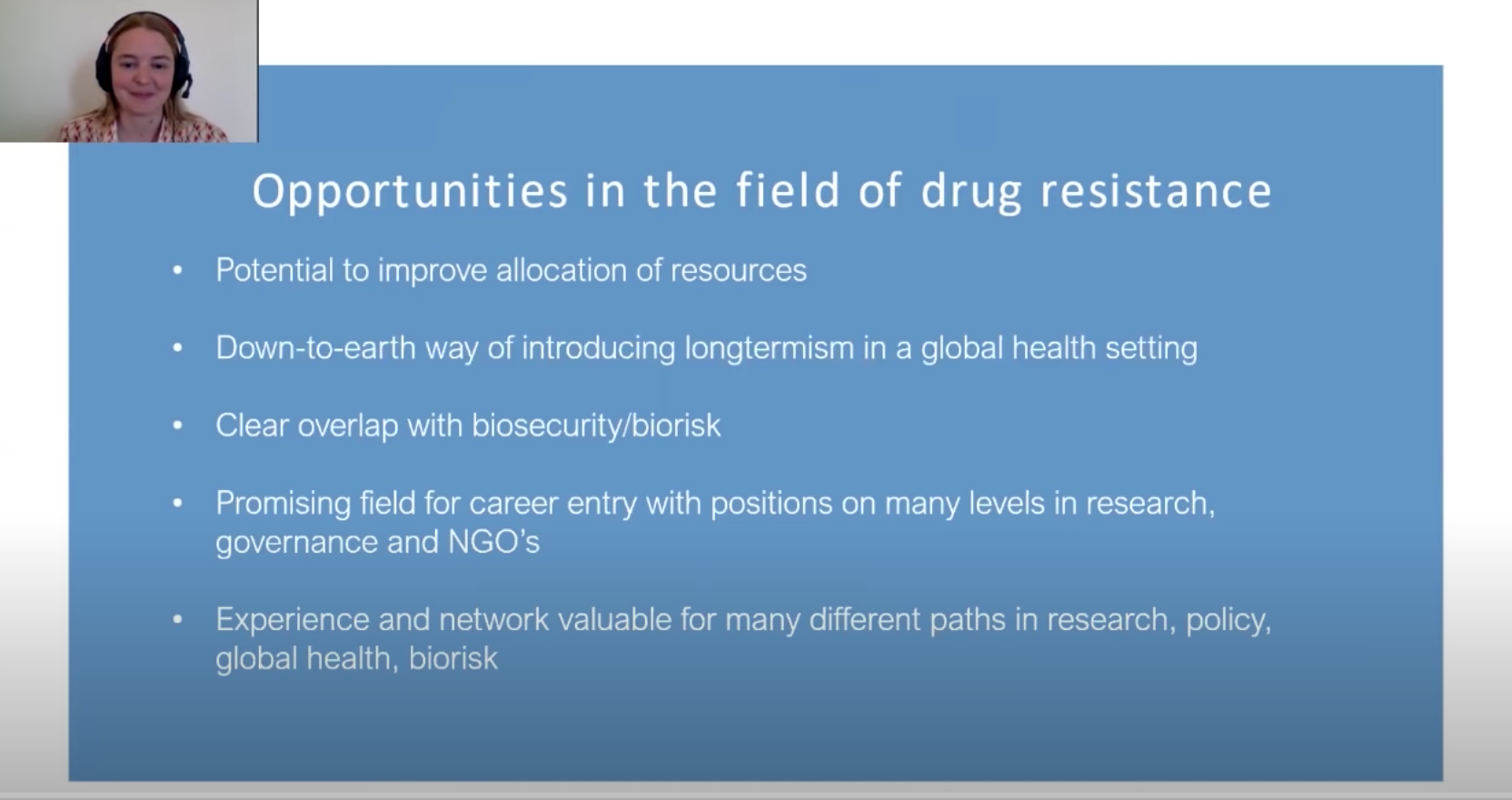
I think this is an opportunity for EAs. We have the potential to improve the allocation of resources already dedicated to this area. I also think that this area interests EAs because it’s a down-to-earth way of introducing longtermism in a global health setting. Antimicrobial resistance is something that people who work in global health are familiar with, and it has clear consequences today that are especially evident in poor countries. Also, it’s a cause that links to [questions around] the healthcare we can expect to have in 100 or 200 years. In this sense, it's an interesting field that [doesn’t present global health and longtermism as opposing causes]. Instead, they go together.
I also think there is a clear overlap between biosecurity and biorisk, both in terms of policy interventions and preventing the spread of infectious disease. This could be a promising field for career entry, because there are positions at many levels in research, government, and NGOs. I think the experience and network you can build in antimicrobial resistance is valuable for many different paths in research policy, global health, and biorisk.
Thank you.
Noga Aharony: Aiming toward a biosecurity career from grad school
Hi, I'm Noga. I'm a master's student in systems biology in Israel and I interned at the
Johns Hopkins Center for Health Security two years ago. In this talk, I'll explain which paths can lead to an effective career in biosecurity.
There are three main disciplines that come together in biosecurity:
- Epidemiology
- International relations
- Biology
However, my sense is that the most-needed people right now are policymakers with a PhD in biology. Let me explain why.
Pandemic preparedness and prevention constantly sits within epidemiology, and epidemiologists already kind of think like effective altruists. So entering this area as an effective altruist won't really give you a competitive advantage.
However, people who completed a recent PhD and have expertise in emerging biotechnologies have [a perspective] that is more rare in the field — and that is especially useful for issues that EA focuses on, like engineered pandemics.
Policymaking is generally a superior path because technical biosecurity work is almost always funded by governments or other nonprofits. Therefore, it's not as constrained by skill. Some EAs have asked me in the past about becoming academics in the field. You have social influence, that is for sure. But academics are funded by grantmakers — so overall, I think it’s advisable to become a grantmaker or part of a body that advises grantmakers if you're entering the field.
The Center for Health Security essentially is [the latter, a body that advises grantmakers]. When I was there, people told me many times that in order to become a valued expert in the field, you need to have a terminal degree: an MD, a JD, or a PhD. If you're not sure whether you can commit to such a long path, the bright side is that internships are a common starting point. However, biology professors are often wary of people with interests in biosecurity, because they see them, sometimes correctly, as anti-science and anti-technology. So be careful about how you present yourself and your experiences if you're planning to pursue a PhD after an internship.
If you're not committed to a biology PhD but do want to enter the field, another common path is to start a fellowship and then get a low-level role in the same [organization]. You can advance there while concurrently getting any additional degrees at the institution where you work.
In terms of the job itself, most jobs are in the US. Having American citizenship really helps in that case, because many jobs also require security clearance. Also, making connections is really important — not only because the field is small, but also it’s full of collaborations for carrying out productive projects.
The list of positions on the
80,000 Hours job board is pretty representative. In addition, there are some projects in the EA community that individuals [conduct], sometimes remotely. So, that's another option.
If you want to get involved, get in touch with me or
Greg Lewis, who's kind of the community’s gatekeeper.
Finally, I'd like to say that although many EAs are starting to direct their trajectory into this field, there's still a lot of work to be done and expertise to be had, especially during and after this current pandemic.
Jennifer-Justine Kirsch: The next frontier: Lessons learned from an EA fish startup
Hello. Thank you for joining my talk. My name is Jennifer, and I'm the Research and Projects Strategist at
Fish Welfare Initiative.
Fifty years ago, the first major campaigns in the animal movement were launched. We started with the most relatable animals, such as primates and rabbits being experimented on. Later, we graduated to farmed animals, initially focusing on cows and pigs.
Now our movement's primary focus is chickens, largely because of the immense number of chickens farmed. This movement is about the expansion of our moral circle, and we're on the verge of the next frontier: fish.
Since no pitch for a good cause would be complete without it, I will quickly run through the [EA case] for fish welfare:
The scale of the issue: Roughly 111 billion fish are alive on farms at any given point. That's more than twice the number of chickens and over 100 times the number of pigs.
The degree of suffering: There's general scientific consensus that fish can feel pain. Yet, conditions on fish farms are often alarming. Fish are crowded in monotonous tanks with dubious water quality, suffer under diseases and parasites, and often have no opportunity to express their natural behaviour. They're generally treated like a commodity without any moral worth.
We took this picture in Vietnam. It shows pangasius catfish being transported to a slaughterhouse. Fish are stored like this in small buckets while fully conscious for 10 to 20 minutes, to say nothing of the trillions of wild fish killed annually.
Despite these immense numbers, fish farming is still a largely neglected [problem]. As we speak, only two EA-aligned organizations focus primarily on fish: the
Aquatic Life Institute and our organization, Fish Welfare Initiative.
The issue’s tractability: We hope our work can demonstrate the tractability of fish welfare work. We’ve already seen some preliminary successes from other organizations. For example, the
RSPCA and
Open Cages successfully pushed for a ban of live fish sales in eastern European countries.
Our work happens in stages:
- We research the most promising ways to help fish.
- We aim to prove that interventions can work with a micro-level pilot program.
- We scale our impact up to the macro level through corporate and governmental outreach.
For the next few minutes, I want to share some of our findings with you.
Fish species and farming systems are extremely diverse. Consider all of the species and farming systems the animal movement has worked with already — from pigs in gestation crates, to chickens in battery cages. Fish are not just one more species. They represent about 370 different species currently farmed by humans, and each of these has very specific welfare needs.
Farming systems are just as diverse. On the left side of the slide, you see the intensive agriculture system; every parameter is controlled and monitored. On the right side, you see [the system for] fish, which are simply left in a pond and given little attention.
Expertise [isn’t mandatory] in this field. Fish Welfare Initiative was founded last year, and our co-founders didn't have prior expertise in the field. Rather, like many of you, they were generalists with a strong drive to do good. So you don't need expertise to get off the ground.
But it sure does help. We learned this lesson when we hired a PhD as our fish welfare specialist. Our research process is dramatically better now.
Even “perfect,” fully developed plans always have unpredictable elements. This is another crucial lesson that you can surely relate to. For example, COVID-19 threw our plans overboard. The farm visits we were doing are now virtually impossible. During this forced break, we've pivoted to working more on building the fish movement and influencing institutions such as seafood certification schemes. We hope that these activities have a similar level of impact as our initial plans.
So how can you help? We would love to hear from you about any high-leverage opportunities, such as public consultation periods for certification schemes. Also,
please circulate our job ads and consider volunteering or being an intern. We'd love to help anyone by connecting them with our network of people who work on fish all over the world.
Thank you for listening and for being part of a movement to expand our moral circle. Enjoy the rest of the conference.
Sid Efromovich: Introducing Generation Pledge
Hello, I'm Sid. I'm one of the co-founders of
Generation Pledge. Generation Pledge exists because we have a problem. Actually, we have myriad problems — and they're compounded by the fact that we don't have enough resources to solve them.
Even if we were to only solve the sustainable development goals set by the United Nations, we would still have an estimated funding gap of $2.5 trillion annually, and that doesn't even include some really crucial cause areas like catastrophic risk prevention or animal welfare.
Fortunately, though, there is an opportunity [to address this shortfall].
There are over 275,000 “ultra high net wealth” individuals (someone with more than $30 million in assets). Collectively, this group owns over $33 trillion.
But unfortunately, this money isn't being used to create the transformations that we'd like to see.
In 2018, out of this pool of money, only $153 billion was donated. That's less than 0.5%, and it's being deployed in ways that we wouldn't consider the most effective.
Most people say that they are donating to “education,” which often [refers to] donors’ alma maters. Other [funds from this pool] are going toward what donors categorize as “healthcare,” by which they mean first-world healthcare causes or specific research that isn't as impactful, global, or longtermist as it could be.
This simply isn’t good enough, because this is such a tremendous opportunity that we're not capitalizing on. This is what we decided to try to shift.
My co-founder and I have unique access to this world because we ourselves are inheritors. Our parents have a lot of wealth that they either generated or inherited themselves. As inheritors, we had the opportunity to work at the intersection between effective impact and ultra high net wealth families. While there, we noticed that there wasn't yet an organization bringing inheritors together to talk about how to use our unique [situation] and the assets that we're set to inherit for effective impact — and to create an educational process for doing that.
That's why we decided to create Generation Pledge. In many ways, it is
Founders Pledge for inheritors, in that we make two commitments:
- To donate at least 10% of everything we inherit within the first five years of inheriting.
- To use “effective impact” as a lens through which we see all of our resources: our assets such as our investments, our business or philanthropic assets, and also our personal resources (our time, energy, and our influence or contacts).
We're just getting started. We had the idea two years ago and have been working tirelessly since. Right now, in June 2020, we're launching our very first cohort of pledgers.
Around 40 people have already committed to the pledge, and based on publicly available numbers, we estimate that this represents around $750 million in pledge dollars, spanning 11 countries. We're just getting started and we're very excited about the possibilities with Generation Pledge.
We could use help [as we continue to grow]. There are three things that you could help us with:
- We're looking to meet more inheritors, so if you are one or know one, please reach out.
- We have a funding gap to cover for 2020 and 2021, so if you know someone interested in funding an EA meta organization, please let us know that as well.
- We're hiring. We're looking for a community director to help us lead in crafting the community as we go through the first cohort and beyond. So we're looking for someone with very strong social and emotional skills and who's comfortable in ultra high net wealth settings.
Thank you for being here at EA Global, and thank you for watching this.
Michael Aird: Why we need a database of existential risk estimates
Let's say you believe that the well-being and flourishing of people who exist in the future matters just as much as it does for people who are alive today. Let's also say you're lucky enough to have $1 billion burning a hole in your pocket. What are you going to do with it?
Maybe you try to reduce the chance of existential catastrophe — something that wipes humanity out or permanently destroys our potential. But is it possible that existential risk (or x-risk) is low enough already — or so hard to reduce — that you should instead find some other way to improve the world? And even if you do focus on x-risks, which ones [should you choose] — nuclear war, biorisk, AI risk? Which particular interventions are best? Remember, you only have $1 billion. You can't do it all.
These sorts of prioritization questions are core to EA, and are just as relevant if you happen to not find yourself with $1 billion to burn — for example, if you're deciding on a career path, or you want to donate a few thousand dollars per year.
There are a lot of factors that go into answering these questions, including personal fit and moral beliefs. But one pivotal set of factors is how likely various existential catastrophes are and how much various actions could change those likelihoods.
Unfortunately, those are really, really hard things to estimate. In fact, it's even hard to know how much you should update your beliefs based on the estimates experts have come up with. Here are some reasons why:
- The evidence that will be most directly relevant to making those estimates are things like “how much time it took [the last time] humanity went extinct or permanently collapsed. This evidence is fairly hard to come by in advance, for obvious reasons!
- Many of the estimates that experts have [shared] so far are basically just quick guesses.
- We receive estimates mostly from people who are more concerned about x-risks than the average person is. So it's possible our sample of estimates might be biased.
- Many of the estimates probably aren't independent of one another, as many of the estimators have likely worked together or read each other's work.
- The work of Philip Tetlock and others suggest that, in many domains, forecasts for events that are even just a few years away are often pretty unreliable.
- It's often hard to interpret precisely what is being estimated. For example, is it just extinction risk, or existential risk more broadly?
Given that litany of challenges, what should we do?
One option would be to give up on having beliefs about which risk is more likely than others, which interventions are likely to reduce risk by more, et cetera. This is a really, really terrible option. Those likelihoods clearly make a difference regarding which risks and interventions we should focus on, and this option makes it impossible to prioritize.
A second option would be to entirely ignore experts' beliefs and be guided only by our own beliefs. This is a merely terrible option, rather than a really, really terrible one. At least we’re heading in the right direction. One problem with this option is that ignoring experts doesn't tend to be a great move in general. Another problem is that most of the challenges with x-risk estimates noted above also apply to one's own beliefs.
A third option would be to just to avoid explicit quantitative estimates — and instead, form more qualitative beliefs and pay attention to qualitative statements like “There is only a remote possibility of extinction due to nuclear war this century” or “X-risk from AI is more likely than x-risk from gamma ray bursts.” This option isn't terrible, but it's still not the best we can do. One reason is that these qualitative judgments about x-risk still suffer from many of the challenges noted above.
Another reason is that using qualitative beliefs or statements can lead to major issues when trying to make decisions, or when two people are trying to work out precisely what each means and whether they agree or not. For example, precisely how low a chance is a “remote possibility”? Is it a one-in-a-billion chance we can safely ignore or a one-in-100 chance that might still warrant a lot of attention, given the stakes? And how much higher is x-risk from AI than x-risk from gamma ray bursts — two times higher, 10 times higher, a million times higher?
So what do I actually suggest we do? What mystical, wonderful fourth option have I saved until now? Well, EAGxVirtual attendee, I'm very glad you asked. The starting point is for people to come up with specific quantities for x-risk estimates, and then for other people to pay attention to these estimates and update their beliefs based on them. That's roughly what many EAs have been doing so far, which is a good thing. For example, in 2008, some researchers provided estimates of the chance of various human extinction events by 2100, such as from nuclear war or natural pandemics. These estimates are referenced often in EA.
But what if a particular set of estimates isn't very reliable, or doesn't reflect the more typical or recent views of experts? After all, this was just an informal survey of around 15 participants from 12 years ago, and it faces many of the challenges noted above. And what if, as a community, we're anchoring too strongly on these particular estimates rather than being influenced by a broader set of use or forming our own independent views? And what if we wanted to know about things that weren't estimated there, such as the chance of permanent dystopia rather than extinction?
To address these concerns, I've built a database for every single estimate I could find of x-risk or similar things, and people can add additional estimates that they've found or made themselves. I'd really encourage you to check out the database. Go to
bit.ly/x-risk to do so. I'd also encourage you to help build up this resource by adding any relevant estimates you come across.
My hope is that this collaboratively built database will allow us to form a much more complete picture of the distributions of views on these matters — both the points of consensus that do exist among experts and the vast uncertainties and disagreements that remain. I hope that this, in turn, improves the high-stakes prioritization decisions we're continually forced to make as people trying to do good better in a world of many problems and limited resources. Thank you.
Jessica McCurdy: The case for virtual cross-university fellowships
Hi. I'm Jessica, and I currently run Yale Effective Altruism. This summer, I'm co-organizing a virtual fellowship with organizers from McGill and Northeastern. In this talk, I want to make the case for more cross-university mentorship and collaboration.
For those who are unfamiliar with EA fellowships, they’ve [been available] at a few universities for several years now, and are now offered in some city groups. There are both introductory and more in-depth fellowships, but mine is an introductory one, so I'll focus on that. The goal for introductory fellowships is to ramp up EA knowledge for a cohort of people.
Many schools have tailored their fellowships differently, but in ours, we select 15 people who are new to EA from a pool of applicants. Then, fellows meet for around nine weeks and have discussions each week covering different cause areas, methods of thinking, and careers. There are also workshops and mentoring opportunities. Basically, these fellowships aim to provide a really high-fidelity model of what EA is and onboard new members.
Usually, these fellowships are geographically bound. However, since we are virtual now, some schools have been moving theirs online and opening them up to other schools. So I’d like to give a huge shout-out to Stanford and Oxford for doing this first. I think it’s awesome, because it gives students who are in places without fellowships the opportunity to participate. Also, it adds a lot of diversity to the cohort, which makes for a much more enriching experience.
Catherine Low from the
Centre for Effective Altruism gave me the idea for the one I'm currently running. It's the Yale Effective Altruism Fellowship moved to a virtual setting, but co-organized by people from other schools with new university groups. These organizers would really like to start fellowships at their respective schools, but they either felt that their group wasn't large enough yet to organize one, or they just didn't know enough about organizing a fellowship. I think this is super-common. Thanks to different schools (and I’ll give a huge shoutout to Harvard), there are a lot of public resources on how to run fellowships. However, it can still be intimidating, especially if you're only one organizer, or one of a few organizers, in a group at a school that’s doesn’t have EA fellowships.
In working with these organizers, I had two main goals:
- They learn how to run a fellowship so that they can do it afterwards.
- They get students from their schools to participate in the fellowship, and then hopefully help them organize fellowships specifically for their school (or at least join their EA group).
I’ve had help in running this fellowship program. Coleen, Anna, and Thomas, who are my co-organizers, have been a huge help in advertising, interviewing, preparing, and running discussions. It seems like a huge win-win. In terms of advertising, 79 people applied. That's really awesome.
Additionally, the overhead needed to expand to different groups is not terribly high, especially if you already have public resources to help run your fellowship or project. The most complicated things were copying my resources outside of my Google Suite, doing some edits in advertising, and making a new Mailchimp account. Other than that, things were the same fellowship procedures I would be doing anyway. So it's low overhead to add other group organizers, which is great.
This form of collaboration and mentorship is not limited to fellowships or university groups. This method could be expanded to various group projects. More established EA groups have a wealth of resources to share with new groups, and thanks to initiatives like the
EA Hub, these are pretty well-documented. However, I still think that the best way to learn how to run something is to actually run it yourself — and that's a lot easier when you're doing it with someone who has done it before.
Overall, cross-group coordination in this [context]:
- Helps new groups get off the ground
- Is a win-win for established groups, since they get organizational help and can pass on their knowledge and practices
- Creates more diversity in your groups and projects
- [Extends] access to EA projects and content to new members
We're still at the start of our fellowship program, but so far it's been going well. I have high hopes. Thank you.
Roy Head: Development Media International and COVID-19
This talk is about the real-life experience of running media campaigns to try and prevent COVID-19 deaths in Sub-Saharan Africa, and to answer the question: Will it actually do any good?
Let me first introduce the organization that I run. It’s called
Development Media International. We’re about as data-driven as you get for a media organization. Everybody knows that radio and television reach a lot of people, but do they actually change behaviors?
Well, there is no proof — not in the entire advertising world or the entire epidemiological world — because no one had done the randomized controlled trials, or it hadn't worked. So we did these, and they did work. They showed a 56% increase in malaria treatment, a 9.7% reduction in child deaths, and a cost-per-life saved in the $200-$800 range. Also, we ran a second trial showing a 20% increase in contraceptive use.
Everything was going really well. We had the evidence, and then we were able to scale it. By January 2020, we were campaigning in nine countries in Sub-Saharan Africa.
Then COVID hit, and we were suddenly plunged into emergency mode. We were all working from home. Some of us actually caught the disease. But we knew that this was a disease which was heavily dependent on people's behaviors. We knew that in order to run campaigns you had to have good relationships with governments and with the media, and we had those in nine countries. We also knew that the last thing to go down, even in Armageddon, would be the radio stations.
At the same time, we were being told by Imperial College London that unless something was done, 2.5 million people were going to die in Africa. So at an emotional level, it felt like something we just had to do. So we went for it. We started producing radio and television spots before we had any money. We paid for it out of reserves. We got on air very quickly in six of our nine countries. Then the money did come in from GiveWell, from the Skoll Foundation, from the Mulago Foundation, from The Life You Can Save, and from some generous private individuals. We received about $1.3 million. We need more, but that amount has carried us through until now.
It has been a strange experience. Usually we deal with health promotion departments and ministries of health. Suddenly we were dealing with the prime minister's office, and with very firm directives being issued to us. We're used to dealing with malaria campaigns where there's 40 years of scientific evidence on what works and what doesn't. Here we're in completely uncharted territory — where no one, not even the World Health Organization (WHO) or the Africa Centres for Disease Control and Prevention know some of the answers. It is a completely different way of working.
Will it work? This is the big question. It all depends on what happens in Africa, and here the epidemiologists’ [estimates] are all over the place. On the one side, you have Imperial College London saying that there will be 2.5 million deaths by the end of the year. There has been more recent study by the London School of Hygiene and Tropical Medicine, which has figures even in excess of that. On the other hand, you have WHO Africa, which thinks [the death toll] will be around 150,000. These are big differences. So we modeled our own cost effectiveness using the Imperial College figures.
Assuming we could increase social distancing by about 10%, we calculated that we'd save about 40,000 lives in the nine countries [where we operate], and that would work out to about $50 per life saved. Those are incredible numbers. We've never seen those before, but they reflect the vast numbers of lives at risk and the fact that the disease and the campaigns really do affect everyone. When using the smaller WHO numbers, our cost-effectiveness would be about a twentieth of that, so around $1,000 per life saved, but that still seems like a pretty good value in my book.
However, at the time of [this conference], the pandemic really hasn't taken off at all [in Africa]. There have been 53 deaths in Burkina Faso, but four in Malawi, two in Mozambique, and none at all in Uganda. We don't know why. It could be because the median age is so young (it's around 9.7 years across Sub-Saharan Africa). It could be because older people live in more rural areas and the disease hasn't found them yet. It could be that the pandemic has been delayed because the continent took very stringent measures far earlier in the epidemic than their counterparts in Europe managed to do. But we really don't know. So we face the unusual prospect that if this carries on, we'll save no lives at all.
That would be a bizarre result for an organization that prides itself almost entirely on its impact. But of course, we'd infinitely prefer that outcome. We can then concentrate on the secondary effects of the pandemic. It's important to remember that more people died of measles and malaria during the Ebola epidemic than died of Ebola itself.
We shall see. These are interesting times.